Per-key batching
Ferry.perKey batches each key's inputs separately and keeps them in order. A key is whatever your updates must
be serialised by: an entity, a stream, a document, a log.
It suits a write path where each entity is updated by a read-modify-write guarded by a conditional write. Such an
entity is limited by round trips, not by work: one round trip applies one update or twenty at about the same cost.
perKey makes the process the only writer of each key, so writers no longer contend, and each round trip carries
everything that arrived while the previous one was in flight.
def writer(store: EventStore): ZIO[Scope, InvalidConfig, Ferry[Event, StoreError, Either[String, Long]]] =
  for
    config <- ZIO.fromEither(PerKeyConfig.make(maxBatchSize = 25, maxInFlightBatches = 8, maxQueueing = 1000))
    ferry  <- Ferry.perKey(config, (e: Event) => e.entity)(store.append)((event, outcomes) => outcomes(event.id))
  yield ferry
The batch call receives the key and that key's inputs, in order. extract hands each caller its own outcome.
Guarantees
- A batch carries one key's inputs, never a mix.
- A key never has two calls in flight. Its next batch leaves only once its previous call has completed.
- A key's inputs are sent in order: submission order by default, or the order you choose.
- Keys don't starve each other. Keys with work waiting take turns. A key that still has inputs when its call completes goes to the back of the line.
- Different keys run in parallel, up to
maxInFlightBatchesbatch calls in total.
How batches form
With the default maxBatchDelay of zero, there is no batching timer. A key's next batch leaves as soon as its previous
call completes and a worker is free, and it carries everything that arrived in the meantime:
- at low load, an input goes out alone, at once;
- at high load, batches grow by themselves, to roughly the arrival rate times the round-trip time, up to
maxBatchSizeandmaxBatchWeight.
This is the group-commit pattern. A fixed delay is right at one load only; dispatching on completion adapts to every load. See 0004.
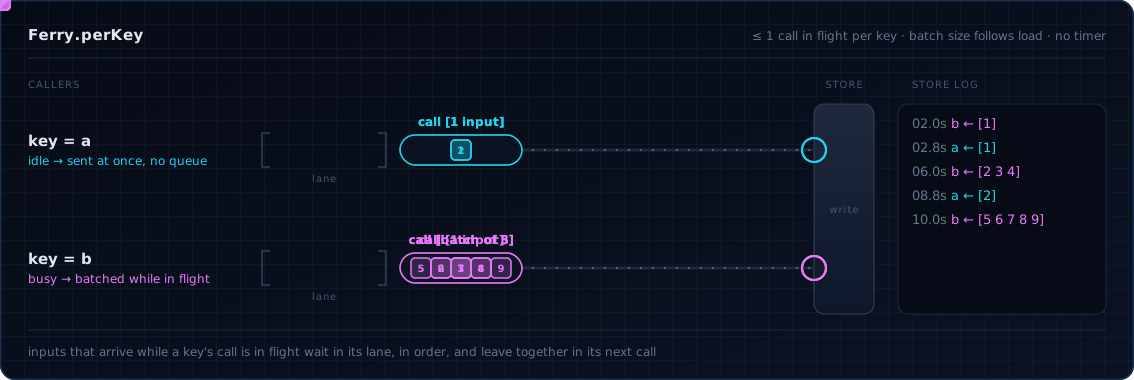
Only busy keys are batched
Most keys are quiet most of the time; a few are busy, sometimes only for a while, during a bulk import or a reprocessing run. With zero delay, an input for an idle key (nothing waiting, nothing in flight) is sent at once by its own caller, as a batch of one. It does not wait for a worker, and does not queue behind busy keys.
Inputs that arrive for the key while that call is in flight wait in the key's lane and are batched behind it. A key therefore switches to batching exactly when it has concurrent work, and back when it is idle again. Nothing has to classify keys as busy up front. See 0010.
Direct calls are not counted against maxInFlightBatches, which bounds the batches of busy keys. In total, concurrent
calls are bounded by maxInFlightBatches plus the number of idle keys called at that moment, the same as without
batching. If the downstream needs one hard bound on concurrent calls, turn direct calls off:
PerKeyConfig.make(maxBatchSize = 25, maxInFlightBatches = 8, maxQueueing = 1000, directIdleKeys = false)
A positive maxBatchDelay turns them off too, since it means "wait for company", even for an idle key.
Bounding by weight
Counts bound neither of the two limits that usually run out: the downstream's request size limit, in bytes, and the
memory held by waiting inputs. Give perKey a weigh function, and set maxBatchWeight and maxQueuedWeight:
def tunedWriter(store: EventStore): ZIO[Scope, InvalidConfig, Ferry[Event, StoreError, Either[String, Long]]] =
  for
    config <- ZIO.fromEither(
      PerKeyConfig.make(
        maxBatchSize = 100,
        maxBatchWeight = 256L * 1024, // the store's request size limit, in bytes
        maxInFlightBatches = 16,
        maxQueueing = 10000,
        maxQueuedWeight = 64L * 1024 * 1024 // bounds the memory held by waiting events
      )
    )
    ferry <- Ferry.perKey(
      config,
      key = (e: Event) => e.entity,
      weigh = (e: Event) => e.payload.length.toLong,
      order = Order.by((e: Event) => e.at)
    )(store.append)((event, outcomes) => outcomes(event.id))
  yield ferry
A batch never weighs more than maxBatchWeight, except a single input that is heavier on its own: it travels alone.
An input that would take the waiting room above maxQueuedWeight is rejected, like one beyond maxQueueing. Both
default to unbounded. Weights are computed once, when the input is submitted. See
0007.
To keep memory bounded, submit references to large payloads (an id, a storage locator), not the payloads.
Outcomes per input
If one input in a batch is invalid, it should fail only its own caller. Let the batch call return one outcome per input and fail only when the batch as a whole did not happen:
callreturns, for example,Map[Id, Either[Rejection, Result]], and applies the valid inputs;callfails only when nothing was applied (the store was unavailable, the write was refused). Every caller in the batch then getsFerryError.Failed, and that is the failure worth retrying;extractpicks each caller's outcome.
See 0006. FoldWrite implements this for the read,
apply, conditional-write round trip.
Next
- Dispatch order: send a key's inputs by effective date, timestamp or sequence number.
- Fenced writes with FoldWrite: the write that makes retries and crashes safe.
- Commit, then project: the same for a store that writes a projected view in a second step.
- Running on a fleet: one writer per key across many processes.