Ferry.make: one queue, one batch assembled at a time
make (and keyed, which is built on it) batches one undifferentiated stream. Its design is recorded in
0001.
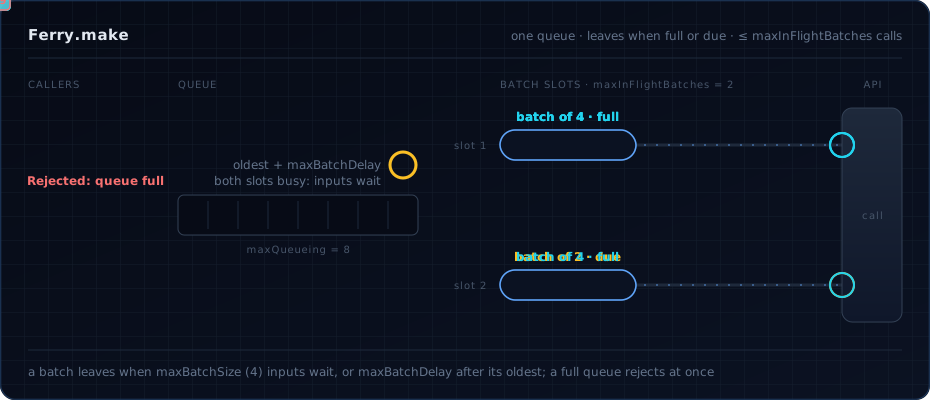
Parts
| Part | What it is | Why |
|---|---|---|
queue |
a bounded, dropping queue of entries (input, promise, submission time) | a full queue refuses at once instead of blocking: Rejected |
doorbell |
a sliding queue of size 1, rung on every admission | wakes a worker that is waiting for more inputs before its deadline |
accepting |
a Ref.Synchronized[Boolean] |
serialises admission with close, so nothing enters a drained queue |
| workers | maxInFlightBatches fibers, forked in the scope |
each assembles and runs one batch at a time |
forming |
a semaphore with one permit | only one worker assembles at a time, so a batch is never split between two idle workers |
inFlight |
a counter | for metrics |
A call
sequenceDiagram
  participant C as caller
  participant A as accepting (lock)
  participant Q as queue
  participant W as worker holding forming
  C->>A: admit(entry)
  alt open and room
    A->>Q: offer(entry)
    A-->>C: admitted
    C->>Q: ring doorbell
  else queue full
    A-->>C: Rejected
  else closed
    A-->>C: interrupt
  end
  Note over C: waits on its promise
  W->>Q: take first (uninterruptibly recorded as owned)
  loop until full or oldest + maxBatchDelay reached
    W->>Q: takeUpTo(rest)
    W->>W: wait for doorbell or deadline
  end
  W->>W: release forming, run batch
  W-->>C: complete promise with extract(input, result) or Failed(e)
Assembling a batch
A worker takes the forming permit, then blocks on the queue for a first entry. The batch's deadline is that entry's
submission time plus maxBatchDelay. Because the deadline belongs to the oldest input, not to when assembly started,
an input that waited while every slot was busy goes out as soon as a slot frees.
The worker then takes whatever else is waiting, up to maxBatchSize. If the batch is not full and the deadline has not
passed, it waits for the doorbell or the deadline, whichever comes first, and tries again. A stale ring costs only one
extra empty take.
It releases forming before running the batch, so the next batch can form while this one is in flight.
Never stranding a caller
- Taking entries off the queue and recording them as owned by the worker is one uninterruptible step. An interrupted worker interrupts every caller it owns.
- Before calling, the worker drops entries whose promise is already complete: their callers were interrupted while waiting.
- On close,
acceptingis set to false under the lock, then the queue is drained and every entry's caller is interrupted. Workers are interrupted first, since finalizers run in reverse order.
formal/Ferry.tla models these steps. Its weakened variants show each one is needed: without serialised admission,
cleanup on interrupt, or the atomic take, a caller is stranded. See Verification.