Batching calls
Ferry.make and Ferry.keyed batch one stream of independent calls. Use them in front of an API that accepts
many inputs per request, where the cost of a request barely depends on how many inputs it carries.
If the inputs belong to entities whose updates must stay in order, use perKey instead.
How a batch forms
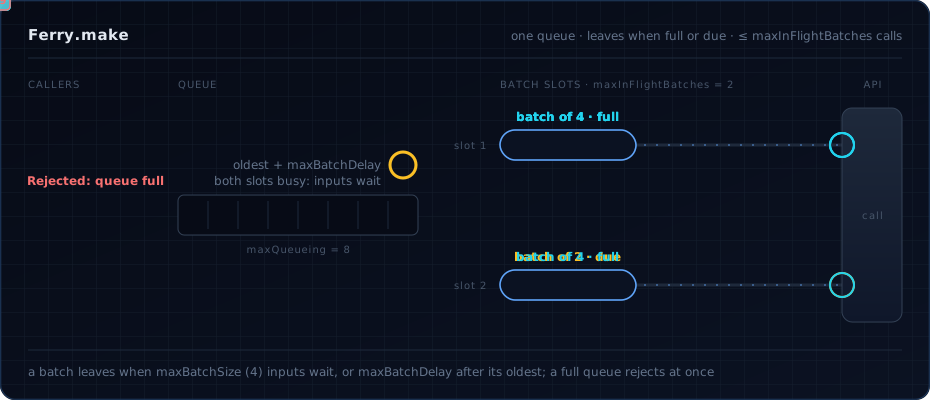
Inputs wait in one bounded queue. A batch is sent as soon as either of these happens:
maxBatchSizeinputs are waiting;maxBatchDelayhas passed since the oldest waiting input arrived.
At most maxInFlightBatches batch calls run at once. While every slot is busy, inputs keep waiting. An input whose
deadline passed while it waited is sent as soon as a slot frees, and its wait does not start over. When
maxQueueing inputs are already waiting, a new call fails at once with FerryError.Rejected.
keyed: one result per distinct input
keyed is for a batch call that answers with a Map from input to result. Each distinct input is sent once per
batch, however many callers ask for it. A caller whose input is missing from the map gets None:
Ferry.keyed(config)((ids: NonEmptyChunk[UserId]) => profiles.fetch(ids)) // Ferry[UserId, E, Option[Profile]]
make: any batch result
make takes the batch call and an extract function that picks one caller's result out of the batch result. Use it
when the result is not a map keyed by input:
def searches(api: SearchApi): ZIO[Scope, InvalidConfig, Ferry[Query, SearchError, Option[Hit]]] =
  for
    config <- ZIO.fromEither(
      FerryConfig.make(maxBatchSize = 50, maxBatchDelay = 10.millis, maxInFlightBatches = 4, maxQueueing = 500)
    )
    // The batch call gets every waiting query; each caller picks its own hit out of the batch's answer.
    ferry <- Ferry.make(config)(api.search)((query, hits) => hits.find(_.query == query))
  yield ferry
make passes every input to the batch call, duplicates included, in the order they were submitted.
If extract throws, only that caller fails, with the exception as a defect.
Handling the answer
A call fails with a FerryError[E]:
def describe(ferry: Ferry[Query, SearchError, Option[Hit]], query: Query): UIO[String] =
  ferry(query).fold(
    {
      case FerryError.Rejected      => "too many queries waiting: back off, then retry"
      case FerryError.Failed(error) => s"the batch carrying this query failed: ${error.message}"
    },
    _.fold("no hit")(hit => s"score ${hit.score}")
  )
| Outcome | Meaning | Worth retrying? |
|---|---|---|
| a result | the batch call succeeded, and extract picked this caller's share |
— |
Rejected |
maxQueueing inputs were already waiting; nothing was sent |
yes, after a backoff |
Failed(e) |
the batch call carrying this input failed with e |
depends on e and on whether the call is idempotent |
| a defect | the batch call or extract died |
no |
| interruption | the ferry's scope closed | the process is shutting down |
toException turns a FerryError into an exception, for code that works in Task.
Retries, timeouts and circuit breakers
Ferry decides how many calls run and which inputs share them. It does not retry. Wrap the batch call in your resilience policies, so that a retry or a timeout covers every caller in the batch at once. With rezilience:
timeout <- Timeout.make(1.second)
retry   <- Retry.make(min = 10.millis, max = 100.millis, maxRetries = Some(2))
breaker <- CircuitBreaker.withMaxFailures[Any](maxFailures = 5)
config  <- ZIO.fromEither(
  FerryConfig.make(maxBatchSize = 5, maxBatchDelay = 20.millis, maxInFlightBatches = 2, maxQueueing = 50)
)
// Policies wrap the batch call, so a retry or a timeout covers every caller in the batch at once.
prices <- Ferry.keyed(config)((countries: NonEmptyChunk[String]) =>
  breaker(retry(timeout(api.fetch(countries))))
)
Put the timeout innermost: it then bounds each attempt, while the retry bounds the attempts, and the breaker sees the final outcome.
Choosing the settings
maxBatchSize: the downstream's per-request limit, or the size beyond which a bigger batch no longer saves anything.maxBatchDelay: the latency you are willing to add to a lone call so that others can join it. Zero sends whatever is waiting at once; batches then form only from calls that arrive while every slot is busy.maxInFlightBatches: the concurrency the downstream can take.maxQueueing: how much may wait before callers are turned away. Roughly: the rate you must absorb in a burst times the latency you can accept. It must be at leastmaxBatchSize.
See Configuration and tuning for the full reference and for monitoring.