Testing real providers
TestFeatureProvider simulates a provider's states: ready, not ready, stale, failing. That covers
almost every test. What it cannot do is run a real provider's own code: its HTTP client, TLS handshake, payload
parsing, start-up and polling. A vendor SDK that hangs on a stalled fetch, or chokes on a 401 or a truncated body,
does so in code the test provider never runs.
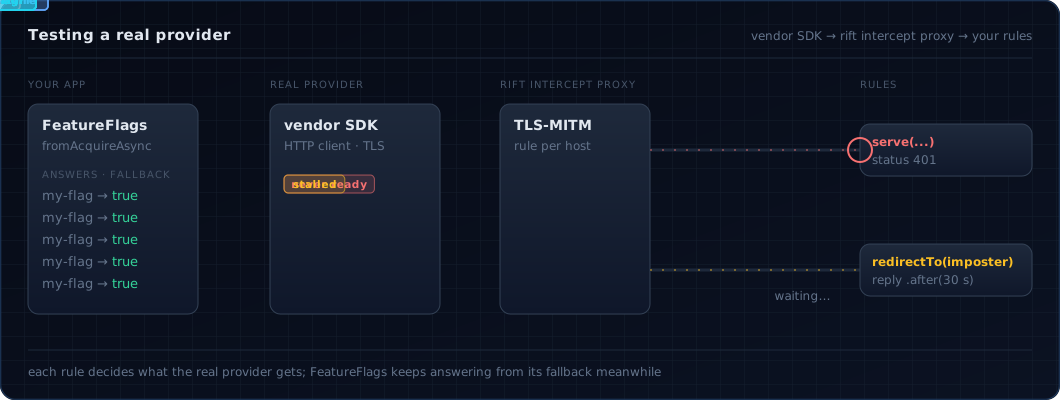
To test that, run the real provider against a real socket with something hostile in between. rift-scala provides it: an in-process TLS man-in-the-middle proxy, plus zio-test fixtures that point the JVM at it. Your test then decides, per host, what the provider's requests get.
These are integration tests. They start a native engine, change JVM-wide proxy and TLS settings, and need a recent JDK. Keep them in a separate test module that you run locally, not in the default CI build. No published module of this library depends on rift.
This repository does exactly that: its provider-fault-tests module runs the real OFREP and Optimizely providers
through the proxy, and the code on this page is that module's code, compiled with the docs. CI compiles the module and
never runs it; see Development.
Setup
Add the fixtures to the test module (rift-scala 0.3.0 or later):
// build.sbt
libraryDependencies += "io.github.achird-labs" %% "rift-scala-zio-testkit" % "0.4.0" % Test

// project/plugins.sbt, for providers that read the JVM truststore (see below)
addSbtPlugin("io.github.achird-labs" % "sbt-rift" % "0.4.0")
The embedded engine also needs rift's platform natives on the test classpath and a forked JVM that may load them:
| JDK | Add |
|---|---|
| 22 or later | rift-java-embedded, and --enable-native-access=ALL-UNNAMED |
| 21 | rift-java-embedded-jdk21, and --enable-preview --enable-native-access=ALL-UNNAMED (with sbt-rift: riftTlsEnablePreview := true) |
This repository's provider-fault-tests module uses the JDK 22 setup: see its settings in build.sbt. Where the
engine cannot load, rift.zio.Rift.isEmbeddedAvailable is false.
Pointing the provider at the proxy
How you wire the proxy depends on how the provider builds its HTTP client. Getting this wrong is the usual reason a test runs but intercepts nothing.
| The provider's HTTP client... | Wiring |
|---|---|
| is one you build and pass in | give it handle.sslContext and handle.proxySelector |
reads ProxySelector.getDefault and SSLContext.getDefault |
intercept.systemProxySelector(handle) and intercept.systemSslContext(handle) |
reads javax.net.ssl.trustStore once, at first use (Apache HttpClient, most vendor SDKs) |
intercept.systemProxyProps(handle), plus a truststore that exists before the test JVM starts |
For the last row, enable the sbt-rift plugin on the test module. It creates a throwaway CA and truststore under
target/rift, forks the test JVM and points it at both:
lazy val providerFaultTests = (project in file("provider-fault-tests")).enablePlugins(RiftTlsPlugin)
intercept.caFromBuildProps() then loads that CA, so the proxy signs its certificates with a CA the JVM trusts. It
fails if the plugin is not enabled. The plugin is opt-in (noTrigger) and its settings are per project, so enabling it
on the fault-test module changes no other module's test JVM.
Give the provider a host with a real-looking top-level domain, such as example.com. The OFREP provider validates its
base URL and rejects .test.
The FeatureFlags side
Build the layer with fromAcquireAsync: it starts on a fallback at once and swaps the real provider
in when it is ready, so a broken network cannot block start-up or fail an evaluation.
// Seeded, so its answer differs from the `default = false` used below. A fallback that agrees with the default
// would make every assertion pass even if the fault never reached the provider.
def seededFallback: FeatureProvider = EnvVarProvider.withLookup(Map("FF_MY_FLAG" -> "true").get)

def flagsLayer(acquire: RIO[Scope, FeatureProvider]): URLayer[Any, FeatureFlags & AcquireStatus] =
  FeatureFlags.fromAcquireAsync(
    acquire = acquire,                     // e.g. ZIO.attemptBlocking(new VendorProvider(sdkKey))
    fallback = ZIO.succeed(seededFallback) // a fresh instance each time it runs
  )
Seed the fallback with a value different from the default your test passes. Otherwise a test that never reached the fault would still pass.
Scenarios worth covering
| Scenario | Rule | Expect |
|---|---|---|
| healthy | serve a valid payload | the provider becomes ready; its values are served |
| slow endpoint | redirect to an imposter that waits ~30 s | a provider that fetches at start-up (Optimizely): start-up does not wait, the fallback's value is served at once. A provider that fetches per evaluation (OFREP): the evaluation timeout ends the call with a typed ProviderError(TimeoutException), in bounded time |
| rejected credentials | serve a 401 |
never ready; the fallback answers; no evaluation fails |
| connection reset | redirect to an imposter with a TCP fault | the same |
| malformed payload | serve a non-JSON body marked application/json |
the same |
Serve rules and imposters
A rule answers in one of two ways:
serve(response)answers with a status, headers and a body, nothing more. A response with a wait, a fault or templating is rejected when you create the rule.redirectTo(imposter)sends the request to an imposter, which supports the full response model, including.after(delay)and.withTcpFault(...).
So waits and faults always go through an imposter.
A suite
The rift side of the fixture keeps the engine in the environment, so tests can create imposters:
import rift.RiftError
import rift.bridge.InterceptConfig
import rift.zio.testkit.intercept as riftIntercept
import rift.zio.{InterceptHandle, Rift}

val layer: ZLayer[Any, RiftError, Rift & InterceptHandle] =
  ZLayer.scopedEnvironment {
    for
      engine <- Rift.embedded.build.map(_.get[Rift])
      ca     <- riftIntercept.caFromBuildProps()
      handle <- engine.intercept(InterceptConfig(ca = Some(ca)))
      _      <- riftIntercept.systemProxyProps(handle)
    yield ZEnvironment(engine, handle)
  }
When every scenario is a plain serve, riftIntercept.tlsIntercept is enough: one layer that yields just the
InterceptHandle.
Each test installs its rules, then evaluates through flagsLayer. Here the provider is Optimizely's, pointed at
cdn.example.com:
import rift.dsl.*
import rift.zio.testkit.aspects as riftAspects
import rift.zio.{InterceptHandle, Rift}
import scala.concurrent.duration.{FiniteDuration, SECONDS}

def spec = suite("real provider under network faults")(
  test("stalled fetch: the fallback answers at once") {
    for
      engine <- ZIO.service[Rift]
      handle <- ZIO.service[InterceptHandle]
      _      <- handle.clearRules
      slow <- engine.create(
        imposter("slow-cdn").stub(
          get("/datafiles/fault-test-key.json").reply(ok.json(datafile).after(FiniteDuration(30, SECONDS)))
        )
      )
      _      <- handle.rule("cdn.example.com").redirectTo(slow)
      result <- bootDidNotBlock.provide(flagsLayer(vendorProvider))
    yield result
  },
  test("rejected credentials: evaluation never fails") {
    for
      handle <- ZIO.service[InterceptHandle]
      _      <- handle.clearRules
      _      <- handle.rule("cdn.example.com").serve(status(401).json("""{"error":"unauthorized"}"""))
      result <- neverFails.provide(flagsLayer(vendorProvider))
    yield result
  }
).provideShared(RiftFixture.layer) @@ TestAspect.sequential @@ TestAspect.withLiveClock @@ riftAspects.embeddedOnly
The suite settings all matter:
provideSharedandsequential. The proxy settings are JVM-wide. They are restored when the scope closes, but two tests must not change them at once.clearRulesfirst. Rules accumulate on the handle; without clearing, an earlier test's rule may match first.withLiveClock. Waits and faults happen in the engine, in real time. On zio-test's default test clock, a timeout measures nothing.riftAspects.embeddedOnly. Marks the suite ignored where the engine cannot load, instead of failing it.aspects as riftAspects. Rename the import: everyZIOSpecDefaulthas its own member calledaspects, which would hide rift's.
.after takes a scala.concurrent.duration.FiniteDuration. Under import zio.*, 30.seconds is a zio.Duration
and does not compile there.
Assertions
The page's FeatureFlags assertions, as used in the suite above:
// "Boot did not block": the fallback answers at once, with its configured value
val bootDidNotBlock =
  FeatureFlags.boolean("my-flag", default = false).map(flag => assertTrue(flag))
// "Never fails": assert on the exit, not the value
val neverFails =
  FeatureFlags.boolean("my-flag", default = false).exit.map(exit => assertTrue(exit.isSuccess))
For code that must never fail, use the total tier (booleanOrDefault and friends), which has no error channel.
For the healthy scenario, wait for the swap through AcquireStatus, which fromAcquireAsync also provides:
// "The real provider swapped in": AcquireStatus says so, no polling needed
val swappedIn =
  ZIO.serviceWithZIO[AcquireStatus](_.changes.takeUntil(_ == AcquireState.Live).runDrain)
Wrap it in a timeout if the provider might never become ready.
What this repository asserts
provider-fault-tests runs every fault above (plus 403, 503, 429, a truncated body and a stalled response)
against both providers, each through FeatureFlags.fromProvider and FeatureFlags.fromAcquireAsync. In every case the
call returns within a bound, and closing the scope does too.
| Provider | Through | Outcome |
|---|---|---|
| OFREP | fromProvider |
rejection, 503, 429 and a timeout are provider errors; a truncated or non-JSON body is a ParseError; the total tier answers the default |
| OFREP | fromAcquireAsync |
error answers fall through to the fallback; a stalled call ends in a typed timeout at the evaluation timeout |
| Optimizely | fromProvider |
the layer fails with the provider's "datafile did not load" error, within its init wait |
| Optimizely | fromAcquireAsync |
the fallback answers at once; AcquireStatus ends in Failed; nothing fails |
Each healthy case checks the opposite: the real provider's value is served, not the fallback's.