Hooks
A hook runs your code around every flag evaluation: to log it, time it, audit it, or add context to it. Hooks are plain ZIO values, written once and registered where they should apply.
Writing a hook
Extend FeatureHook and override the stages you need. Every stage has a no-op default.
val audit: FeatureHook = new FeatureHook:
  override def after[A](ctx: HookContext, details: FlagResolution[A], hints: HookHints): UIO[Unit] =
    ZIO.logInfo(s"${ctx.evaluationContext.targetingKey.getOrElse("anonymous")} got ${ctx.flagKey} = ${details.value}")

  override def error(ctx: HookContext, error: FeatureFlagError, hints: HookHints): UIO[Unit] =
    ZIO.logWarning(s"${ctx.flagKey} failed: ${error.message}")
| Stage | Runs | Receives |
|---|---|---|
before |
before the provider is called | the context so far; may return extra context |
after |
when the provider answered with a value and no error code | the FlagResolution |
error |
when the evaluation failed or the provider answered with an error code | the FeatureFlagError |
finallyAfter |
always, last | Some(resolution) if the provider answered, otherwise None |
Every stage also receives the HookContext (below) and the evaluation's HookHints.
Registering hooks
val register: ZIO[FeatureFlags, Nothing, Unit] =
  for
    _ <- FeatureFlags.addHook(audit)                                            // client: this FeatureFlags instance
    _ <- FeatureFlags.addHooks(List(FeatureHook.logging()))                     // several at once, run in list order
    _ <- FeatureFlags.addZioApiHook(FeatureHook.metrics((_, _, _) => ZIO.unit)) // runs before client hooks
  yield ()

// Invocation: hooks and hints for one call only
val once: ZIO[FeatureFlags, FeatureFlagError, FlagResolution[Boolean]] =
  FeatureFlags.booleanDetails(
    "new-ui",
    false,
    EvaluationContext.empty,
    EvaluationOptions(audit).withHint("requestId", "r-17")
  )

// At construction, before the first evaluation
val config: FeatureFlagsConfig = FeatureFlagsConfig().withHook(audit)
| Level | Register with | Applies to |
|---|---|---|
| ZIO API | addZioApiHook, addZioApiHooks |
every evaluation of this instance, ahead of client hooks; a FeatureFlagRegistry copies them to all its clients |
| Client | addHook, addHooks, FeatureFlagsConfig().withHook(...) / withHooks(...) |
every evaluation of this instance |
| Invocation | EvaluationOptions(hooks*), .withHook, .withHooks |
one call, through its *Details method |
| Java API | addApiHook(javaHook) |
a dev.openfeature.sdk.Hook, run by the Java SDK |
| Provider | the provider itself | run by the Java SDK |
FeatureFlags.hooks and zioApiHooks list what is registered; clearHooks, clearZioApiHooks and clearApiHooks
remove it. The Java API is shared by every instance on the same OpenFeatureAPI, so clearApiHooks from a shared
instance also clears its siblings' API hooks, and logs a warning when it does.
val manage: ZIO[FeatureFlags, Nothing, List[FeatureHook]] =
  for
    client <- FeatureFlags.hooks         // the client hooks, in order
    api    <- FeatureFlags.zioApiHooks   // the ZIO API hooks
    _      <- FeatureFlags.clearHooks
    _      <- FeatureFlags.clearZioApiHooks
    _      <- FeatureFlags.clearApiHooks // the Java SDK hooks
  yield api ++ client
Hooks written for the Java SDK
Hooks from the Java ecosystem can be reused. They run inside the SDK call, together with the provider's own hooks, so from the ZIO hooks' point of view they are part of "calling the provider".
// A hook written against the OpenFeature Java SDK runs inside the SDK call
val javaHook: dev.openfeature.sdk.Hook[Object] = new dev.openfeature.sdk.Hook[Object] {}

val registerJava: ZIO[FeatureFlags, Nothing, Unit] = FeatureFlags.addApiHook(javaHook)
Order
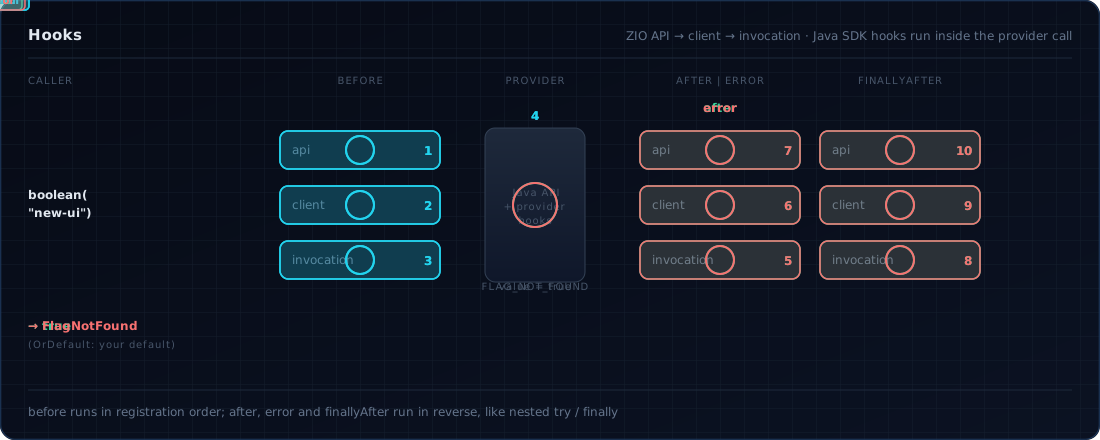
beforeruns ZIO API hooks, then client hooks, then invocation hooks, each in the order they were added.- The provider is called. Java API hooks and provider hooks run here, inside the SDK.
after,errorandfinallyAfterrun in the reverse order: invocation, client, ZIO API.
So the first hook to see an evaluation is the last to see its outcome, like nested try / finally blocks.
When each stage runs
- A clean answer runs
after, thenfinallyAfter. - An answer that carries an error code (
FLAG_NOT_FOUND,TYPE_MISMATCH, ...) runserror, notafter. This holds for both the typed and the total tier:booleanOrDefaultstill serves your default, and the hooks still see the error. - A failure without an answer (provider not ready, timeout, exception) runs
error, andfinallyAftergetsNone. - Hooks run before the provider status is checked, so an evaluation that fails because the provider is not ready still
runs
before,errorandfinallyAfter. - Hooks also run for values served by a transaction override or its cache.
Stages return UIO: a hook cannot fail an evaluation, and a misbehaving logger never takes your flags down. Handle
anything that may fail inside the hook:
// Stages return UIO: a hook cannot fail an evaluation. Handle anything that may fail inside it.
def safe(send: String => Task[Unit]): FeatureHook = new FeatureHook:
  override def after[A](ctx: HookContext, details: FlagResolution[A], hints: HookHints): UIO[Unit] =
    send(ctx.flagKey).ignoreLogged
A defect (a thrown exception) is different. A defect in before or after skips the rest of that stage, runs error
with a ProviderError, runs finallyAfter, and then fails the evaluation with that defect. After an after defect,
finallyAfter receives your default with reason Error and code General.
Adding context in before
before may return extra context. It is merged on top of the evaluation's context, so it wins over every
context level. Each later hook sees the context as changed by the earlier ones.
// `before` may return extra context; it is merged on top of everything else
def stampRegion(region: String): FeatureHook = new FeatureHook:
  override def before(ctx: HookContext, hints: HookHints): UIO[Option[EvaluationContext]] =
    ZIO.some(EvaluationContext.empty.withAttribute("region", region))
To add context from somewhere the application already holds it, without letting it override what callers pass explicitly, use a context source instead.
Passing data between stages
HookData is a small store private to one hook during one evaluation. Write in before, read in a later stage. Use a
TypedKey to keep the value's type. This holds inside FeatureHook.compose too: each hook in a composite gets its own
HookData per evaluation, even when the composite is registered once and shared, or lists the same hook twice.
// HookData is private to one hook for one evaluation: set it in `before`, read it in a later stage
val timer: FeatureHook = new FeatureHook:
  private val startedAt = TypedKey[Long]("timer.startedAt")

  override def before(ctx: HookContext, hints: HookHints): UIO[Option[EvaluationContext]] =
    Clock.nanoTime.map(now => ctx.hookData.set(startedAt, now)).as(None)

  override def finallyAfter(ctx: HookContext, details: Option[FlagResolution[_]], hints: HookHints): UIO[Unit] =
    Clock.nanoTime.flatMap { now =>
      val took = ctx.hookData.get(startedAt).fold(0L)(now - _)
      ZIO.logDebug(s"${ctx.flagKey} took ${took / 1000} µs")
    }
HookHints are read-only values the caller hands to every hook of one evaluation, through EvaluationOptions:
// Hints are read-only values the caller hands to every hook of one evaluation
val requestIdLogger: FeatureHook = new FeatureHook:
  override def after[A](ctx: HookContext, details: FlagResolution[A], hints: HookHints): UIO[Unit] =
    ZIO.logInfo(s"[${hints.getOrElse[String]("requestId", "-")}] ${ctx.flagKey} = ${details.value}")
Pass them with EvaluationOptions(...).withHint("requestId", "r-17"), as in the registration example above.
Filtering by flag type
A hook runs only for evaluations whose type is in its supportedFlagTypes (all types by default). The type is the
one the provider is asked for, so a string-backed enum counts as String.
// Only runs for String flags (and string-backed custom types such as enums)
val stringsOnly: FeatureHook = new FeatureHook:
  override def supportedFlagTypes: Set[FlagValueType] = Set(FlagValueType.String)

  override def after[A](ctx: HookContext, details: FlagResolution[A], hints: HookHints): UIO[Unit] =
    ZIO.logInfo(s"variant ${details.value} for ${ctx.flagKey}")
FlagValueType has Boolean, String, Int, Long, Double and Object.
Built-in hooks
val logging: FeatureHook = FeatureHook.logging(logBefore = false, logAfter = true, logError = true)

val structured: FeatureHook = FeatureHook.structuredLogging(
  afterLevel = Some(LogLevel.Info),
  logContext = true,
  redactKeys = Set("email") // logged as [REDACTED]
)

val metrics: FeatureHook = FeatureHook.metrics { (flagKey, duration, success) =>
  ZIO.logInfo(s"$flagKey took ${duration.toMillis} ms (success = $success)")
}

val detailedMetrics: FeatureHook = FeatureHook.metricsDetailed(
  onSuccess = (ctx, resolution, duration) => ZIO.logInfo(s"${ctx.flagKey} -> ${resolution.reason} in $duration"),
  onError = (ctx, error, duration) => ZIO.logWarning(s"${ctx.flagKey} failed after $duration: ${error.message}")
)

// Logs a warning when the context lacks these; it never fails the evaluation
val validator: FeatureHook = FeatureHook.contextValidator(
  requireTargetingKey = true,
  requiredAttributes = List("plan")
)
| Hook | What it does |
|---|---|
FeatureHook.logging(logBefore, logAfter, logError) |
plain log lines: before at debug (off by default), after at info, error at error |
FeatureHook.structuredLogging(beforeLevel, afterLevel, errorLevel, logContext, redactKeys) |
log lines with annotations: flag.key, flag.type, flag.provider, flag.domain, flag.value, flag.reason, flag.variant, flag.duration_ms, flag.error, and with logContext the context, minus redactKeys |
FeatureHook.metrics((key, duration, success) => ...) |
calls you once per evaluation with its duration |
FeatureHook.metricsDetailed(onSuccess, onError) |
the same, with the full HookContext and resolution or error, to build metric tags |
FeatureHook.contextValidator(requireTargetingKey, requiredAttributes) |
logs a warning when the targeting key or an attribute is missing; never fails the evaluation |
FeatureHook.noop |
does nothing |
FeatureHook.compose(hooks) |
one hook that runs several, in the order above |
HookContext
| Field | Meaning |
|---|---|
flagKey |
the flag being evaluated |
flagType |
the FlagValueType the provider is asked for |
defaultValue |
the caller's default, as the caller's type (a custom type, not its wire value) |
evaluationContext |
the merged context, including earlier before additions |
clientMetadata |
the client's domain and version |
providerMetadata |
the provider's name and version |
hookData |
this hook's HookData for this evaluation |
Keep hooks fast
Hooks run on the calling fiber, in sequence, on every evaluation. Keep them in memory; fork slow work (such as sending
analytics) with .forkDaemon. An evaluation with no applicable hooks skips the hook machinery entirely.